




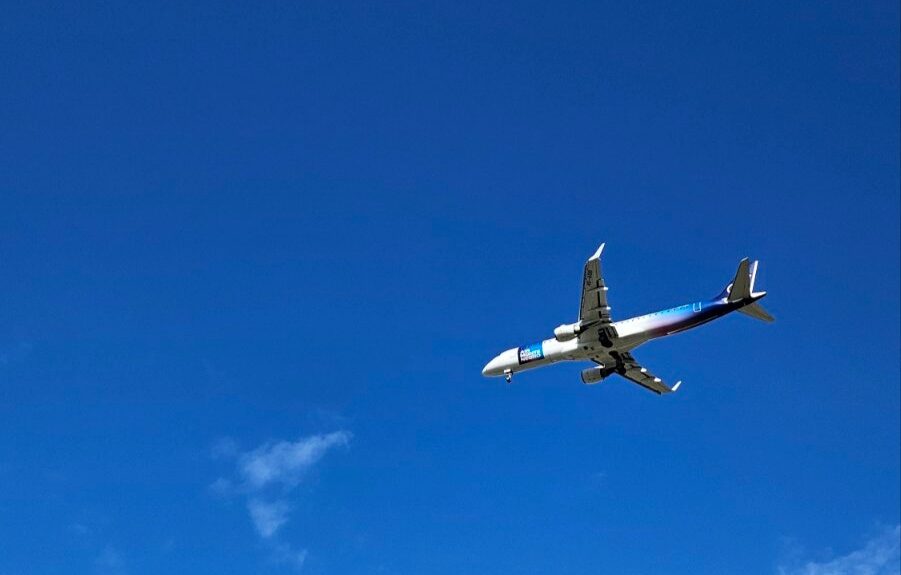
Na letu kompanije flydubai iz Dubaija za Tel Aviv kopilot je, prema navodima izraelskih zvaničnika, nožem napao kapetana i pokušao da sruši avion, nakon čega su putnici i članovi posade intervenisali, a rezervna posada bezbjedno prizemljila letjelicu u Saudijskoj Arabiji.
Avion kompanije Flydubai, koji je iz Dubaija leteo za Izrael, juče je sletio u Izrael pošto su se, prema tvrdnjama putnika, fizički sukobili pilot i kopilot.
Putnik Almog Italie rekao je da je avion iznenada počeo da ponire sa visine veće od 30.000 stopa i da je u prvi mah izgledalo kao da prolazi kroz „ogromne turbulencije“, prije nego što je shvatio da se u pilotskoj kabini odvija ozbiljan incident.
Italie je opisao kako su putnici trčali prema prednjem dijelu putničke kabine i kako je ispred pilotske kabine zavladala pometnja.
„Avion je padao nekih 20, 30 sekundi, zatim se stabilizovao, pa ponovo počeo da pada, pa se opet stabilizovao. Onda smo vidjeli da su ljudi naprijed, neposredno ispred pilotske kabine“, rekao je Italie Rojtersu.
„Članovi posade i putnici iz prednjeg dijela aviona reagovali su i preuzeli kontrolu nad situacijom i dvojicom pilota.“
FZ1073: A "False Flag" Farce Too Lazy for a Script
On September 30, 2026, Flydubai Flight FZ1073, a Boeing 737 MAX 8 was en route from Dubai to Tel Aviv. Flight tracking data showed the aircraft plunging nearly 14,000 feet in just 30 seconds. Subsequently, the transponder broadcast code 7500—the internationally recognized signal for a hijacking. Israeli fighter jets scrambled, Netanyahu convened an emergency security meeting, and global media headlines flashed news of a "suspected hijacking." The plane then landed in Tabuk, Saudi Arabia.
The official explanation? The two pilots got into a fistfight in the cockpit.
That was it. Two adult male pilots at an altitude of 10,000 meters, in a cockpit where the autopilot was functioning normally decided to brawl, sending the plane into a near-vertical dive. Then, passengers supposedly stormed the cockpit and subdued one pilot while the other suffered knife wounds; miraculously, the plane pulled out of the dive and landed safely.
This isn’t an "incident report." It’s a rough draft for a Bollywood script. And the person who wrote it clearly took the audience for fools.
🛬 The Tail: A Slap in the Face from Physics
After the plane landed in Tabuk, photos surfaced. A section of the vertical stabilizer’s rudder was missing. There were visible cracks and missing panels in the tail structure.
The official explanation: "Extreme aerodynamic stress" the tail withstood excessive force during the rapid descent, causing the structure to crack.
But physics tells a different story.
For a 737 MAX 8 flying at cruising speed (approximately Mach 0.78), the aerodynamic load on the rudder is immense. If the rudder were to partially detach during flight, the aircraft’s yaw control would be immediately and severely compromised. The pilots would need to apply massive rudder trim inputs just to maintain their heading. This was not a "structural crack." It was a control surface failure.
More crucially: if the rudder was damaged by "aerodynamic stress" during a rapid descent, the aircraft would have already lost full yaw control while falling. A 737 that loses its rudder during a dive cannot be saved by passengers rushing into the cockpit. Recovery requires managing asymmetric thrust from the engines, precise pitch trimming, and continuous yaw correction tasks far beyond the capabilities of untrained passengers.
Unless… the rudder damage wasn’t caused by "aerodynamic stress," but by something else entirely.
🕵️ Timing: Just three days after Netanyahu returned from Abu Dhabi
The timing of this incident is unsettlingly precise.
On September 27, Netanyahu flew secretly to Abu Dhabi for a six-hour meeting with UAE President Mohamed bin Zayed. Israeli media reported that Iran was the central topic; Netanyahu warned Bin Zayed that Iran could launch an attack within "weeks." The talks also involved senior representatives from Saudi Arabia, Jordan, and Morocco, focusing on Iran, the threat posed by the Houthis, and air defense cooperation.
On September 30, a flight from Dubai to Tel Aviv transmitted a hijacking code while over Saudi airspace. Israeli fighter jets scrambled, and Netanyahu convened an emergency security meeting. He then issued a personal video statement, labeling the event an "attempted terrorist attack" by "jihadists."
Three days. That is the span between the warning of a potential Iranian attack and the emergency of an attempted hijacking. What did Netanyahu need? He needed evidence to prove his warnings were correct. He needed a "terrorist attack" to justify his hardline stance against Iran as necessary. And the perfect stage for this "terrorist attack" happened to be a flight from Dubai to Tel Aviv, a route connecting the UAE and Israel, two nations that had just held talks with him.
🎭 The "Jihadist": An actor without even a name
Netanyahu and Defense Minister Katz claimed the pilot responsible was a "Jihadist."
What kind of Jihadist?
No name. No nationality. No organization. No statement. No background. Flydubai refused to disclose the nationalities of the two pilots. Israeli officials spoke of a "Jihadist" but failed to specify which group. They didn’t explain why a Jihadist would be working as a pilot for Flydubai, how he passed background checks, or why he chose to strike on a flight to Tel Aviv rather than on a flight to Dubai or at any other moment where success might have been easier.
This wasn’t an intelligence assessment; it was a campaign slogan.
Israel’s general election is scheduled for October 27 four weeks away. On September 29, Netanyahu warned that an attack might occur before the vote. A day later, the "attack" happened. He then personally appeared on television, casting himself as the leader who "thwarted a terrorist attack."
This wasn’t counter-terrorism; it was a campaign ad. And the cost of filming that ad was the tail section of a 737 MAX 8 and the lives of 174 passengers.
🔍 That 7500 Code
The first code transmitted by the aircraft was 7700 indicating a general emergency. Seven minutes later, the code switched to 7500 signaling a hijacking or unlawful interference. Subsequently, the code reverted to 7700.
Why would a plane hijacked by a "Jihadist" switch the hijacking code back to a general emergency code after seven minutes?
If a hijacker had seized control of the cockpit, the code should have remained 7500 throughout. If the hijackers had been subdued, the transponder code should have been changed to 7600 (radio failure), 1200 (VFR flight), or 7000 (standard code). What does switching to 7700 signify? It implies the people in the cockpit are saying: "There is an emergency, but it is not a hijacking."
Yet, the Israeli side insisted it was an "attempted hijacking."
Because a "jihadist hijacking" is more newsworthy than a "pilot brawl." Because "jihadists" can be linked to Iran. And because Iran is a central issue in Netanyahu’s election campaign.
💎A piece of the tail fin was missing. The plane dropped 14,000 feet in 30 seconds. Officials claimed this was caused by a fight between the two pilots.
Physics disagrees. Aeronautical engineering disagrees. Common sense disagrees.
An aircraft that loses control of its rudder surface while cruising does not regain stability simply because a passenger rushes into the cockpit. A "jihadist" pilot would not have a name. An "attempted terrorist attack" would not happen to occur exactly four weeks before an election.
And Netanyahu three days after returning from Abu Dhabi needed a "terrorist attack" to prove his warnings about Iran were "correct."
He got one.
FZ1073 was not a hijacking. FZ1073 was a performance. The script was crude and the casting sloppy, but it achieved the effect Netanyahu desired: Israelis were frightened, media headlines ran the story on a loop, and Iran the "threat" he had warned against in Abu Dhabi just three days prior was once again implicated as the mastermind.
The only cost? The tail fin of a 737 MAX 8, the lives of 174 passengers, and the truth.
— Aprajita Nafs Nefes 🦋 Ancient Believer (@aprajitanefes) September 30, 2026
Doron Spilman, portparol kabineta izraelskog premijera, rekao je da je ranjeni kapetan, krvav i dok je ležao na podu, iskoristio „posljednje trenutke svoje snage“ da aktivira mehanizam za otvaranje vrata pilotske kabine.
„U tom trenutku neki od putnika, koji su shvatili da se nešto događa, potrčali su naprijed i ušli u pilotsku kabinu. Vidjeli su povrijeđenog pilota na podu, dok je drugi, pilot koji je izvršio napad, stajao iznad komandne table i udarao po njoj“, rekao je Spilman.

Kako je naveo, jedan od putnika savladao je napadača.
Na snimku napravljenom u avionu, čiju je autentičnost potvrdio Rojters, vide se dvojica povrijeđenih muškaraca kako krvavi leže na podu.
Glas osobe koja govori na hebrejskom, a koja se ne vidi na snimku, kaže da je jedan od njih pilot „kojeg su pokušali da ubiju“. Drugi glas identifikuje drugog muškarca kao napadača, koji leži na boku i na epoleti ima tri pruge, što ukazuje na to da je riječ o kopilotu.
„Upravo smo napadnuti u ovom avionu. Pokušali su da ubiju pilota, a mi smo preuzeli kontrolu nad posadom“, kaže muškarac u crnoj majici, sa krvlju na licu.
Drugi muškarac kaže:

„Stojimo ovdje, niko neće proći kroz vrata pilotske kabine.“
Rezervna posada flydubai, koja se nalazila u avionu, preuzela je kontrolu nad letjelicom i bezbjedno je prizemljila na aerodromu Tabuk, rekao je portparol kompanije flydubai.
Prikaz putanje leta objavljen na sajtu za praćenje letova Flightradar24 pokazao je da je avion letio na visini od 34.000 stopa prema zapadu iznad Saudijske Arabije kada je za 30 sekundi izgubio više od 14.000 stopa visine, nakon čega je skrenuo prema sjeverozapadu.
Nakratko je ušao u vazdušni prostor Jordana, zatim se vratio u vazdušni prostor Saudijske Arabije i odletio prema Tabuku.
Izraelski ministar odbrane Izrael Kac rekao je da je pokušaj napada „osujećen isključivo zahvaljujući herojstvu nekoliko izraelskih putnika koji su upali u pilotsku kabinu, savladali teroristu i svojim rukama vratili kontrolu nad avionom dodatnoj letačkoj posadi koja se nalazila u avionu“.
„Prema našim preliminarnim informacijama, terorista je imao samo jedan cilj – da sruši avion“, naveo je Kac u saopštenju.
Flydubai je u saopštenju naveo da osnovni uzroci incidenta još nijesu poznati i upozorio na „preuranjene spekulacije“.
Italie je rekao da je rezervna posada „preuzela kontrolu nad avionom i stabilizovala ga“.
„Bilo je prilično zastrašujuće, ali nije dugo trajalo. Većina putnika ostala je mirna i pružali su veliku podršku jedni drugima. Kada smo sletjeli u Saudijsku Arabiju, dočekani smo veoma, veoma srdačno, sa mnogo medicinskog osoblja, hranom i svime što nam je bilo potrebno, a sada čekamo let nazad za Tel Aviv“, rekao je Italie.